

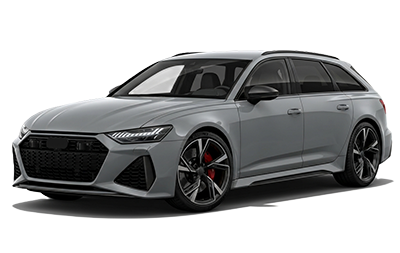

IDV in insurance refers to the Insured Declared Value (IDV): the maximum amount an insurer agrees to pay if the insured car is stolen or declared a total loss. It is fixed at the start of the policy and reviewed at every renewal.
IDV in vehicle insurance is not the same as the invoice price the owner originally paid. It is based on the manufacturer's listed ex-showroom price for that make and model, adjusted downward for depreciation based on the age of the vehicle. This makes IDV in motor insurance a depreciation-linked figure, not a fixed one.
The insured declared value matters because it sets the ceiling for total-loss and theft claims. It also has a direct bearing on the premium a policyholder pays, which is covered further in this article.
The standard formula insurers use is straightforward:
IDV value = (manufacturer's listed selling price of the car) minus (depreciation based on the vehicle's age), plus the value of any registered accessories after their own depreciation.
For example, if a car's ex-showroom price is ₹10,00,000 and the applicable depreciation for its age is 30%, the IDV value of car works out to approximately ₹7,00,000, subject to policy terms and any accessory adjustments.
This depreciation-based approach is standardised across insurers because IRDAI prescribes the age brackets and percentages that apply. The IDV calculator tools available online typically follow this same formula, using the vehicle's registration date to determine which depreciation slab applies.
IRDAI has laid down a fixed depreciation schedule that all insurers, including Universal Sompo, apply when fixing the IDV coverage on a two-wheeler policy. The rates depend purely on the age of the vehicle from the date of registration:
| Age of the vehicle | Depreciation rate |
|---|---|
| Not exceeding 6 months | 5% |
| Exceeding 6 months but not exceeding 1 year | 15% |
| Exceeding 1 year but not exceeding 2 years | 20% |
| Exceeding 2 years but not exceeding 3 years | 30% |
| Exceeding 3 years but not exceeding 4 years | 40% |
| Exceeding 4 years but not exceeding 5 years | 50% |
Several elements influence where a car's IDV lands within the depreciation framework:
older cars fall into higher depreciation brackets, which lowers the IDV.
The manufacturer's listed price varies by brand, variant, and city of registration.
non-standard fittings such as a CNG kit are valued and depreciated separately.
heavily used or poorly maintained vehicles may see the IDV negotiated downward at renewal.
Ex-showroom prices differ by state, which can shift the base figure used for calculation.
Each of these factors contributes to the final figure shown on the policy schedule, which is why two similar cars can have different IDVs.
IDV and premium move in the same direction: a higher IDV generally means a higher own damage (OD) premium, since the insurer is taking on a larger potential payout. A lower IDV can typically reduce the premium, but it also lowers the maximum amount payable on a total-loss or theft claim.
This trade-off is worth thinking through carefully rather than defaulting to the lowest possible figure. Setting the car insurance IDV value too low to save on premium can leave a policyholder underinsured relative to the car's actual worth.
Insurers such as Universal Sompo calculate the OD component of the premium using the IDV as a base, applying the insurer's rate to arrive at the final own damage premium, subject to policy terms and conditions.
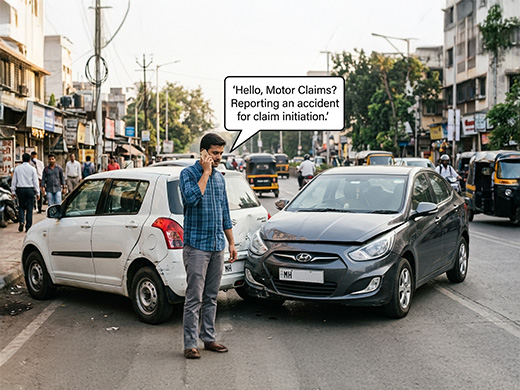
IDV becomes directly relevant when a car is stolen or is assessed as a Constructive Total Loss (CTL), which typically applies when repair costs exceed 75% of the IDV, subject to the specific policy wording. In such cases, the claim payout is generally based on the IDV recorded on the policy, minus any applicable deductions such as compulsory excess.
For repairable damage that does not amount to a total loss, IDV does not usually determine the payout directly. Instead, the claim is assessed on the actual repair cost, subject to depreciation on parts and the terms of any add-on cover, such as a zero depreciation add-on, that may be attached to the policy.
Because of this, an accurately fixed IDV is important primarily for theft and total-loss scenarios rather than for everyday repair claims.
IDV is not carried forward unchanged from year to year. At each renewal, the insurer recalculates the IDV value based on the car's updated age, applying the next applicable depreciation slab from the IRDAI schedule.
This means the IDV, and consequently the OD premium, generally reduces gradually with each renewal cycle as the vehicle ages. Policyholders can usually review and, within a permissible range, discuss the proposed IDV with the insurer before the renewal is finalised, subject to the insurer's underwriting guidelines.
Reviewing the IDV at renewal is a useful checkpoint to confirm that the declared value still reflects the vehicle's condition and any accessories added since the last policy period.

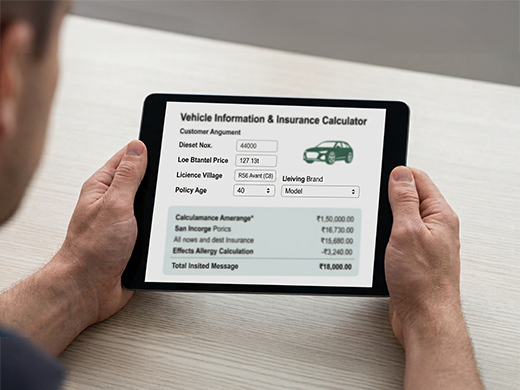
An online IDV calculator simplifies the process by applying the IRDAI depreciation schedule automatically. To use one, a policyholder typically needs to enter the following:
Once these details are entered, the IDV calculator applies the relevant depreciation percentage and displays an estimated IDV instantly. This gives policyholders a quick reference point before discussing the final figure with the insurer at the time of purchase or renewal.
With Universal Sompo's car insurance offering, policyholders can access this kind of tool online to get a preliminary estimate before finalising their policy details.

IDV in car insurance is the figure that determines both the compensation payable on a total-loss or theft claim and, indirectly, the size of the own damage premium. It is calculated using IRDAI's standard depreciation schedule, based on the vehicle's age and ex-showroom price, and is revised at every renewal.
Understanding how this figure is derived helps policyholders avoid being underinsured while keeping premiums reasonable. For those reviewing their coverage, Universal Sompo's car insurance plans offer a straightforward way to check and discuss the IDV before the policy is finalised.